
14 KiB
14 KiB
Project Context: PetCLinic Microservices -> AWS
Context and Scope
This project will migrate the Spring PetClinic Microservices demo from its local/on-premise setup to AWS Cloud. The focus is infrastructure modernization, CI/CD automation, observability, and resilience but not application feature development.
Stakeholders
| Role | Responsibility |
|---|---|
| Project Sponsor | Funding, final approval |
| Project Manager | Scheduling, stakeholder coordination |
| Cloud Architect | Architecture, service selection |
| Dev Lead | App changes for cloud readiness |
| DevOps Engineer | CI/CD, IaC, deployments, monitoring |
| Security Team | IAM, encryption |
| End Users / Demo Audience | Acceptance and usability feedback |
Expectations
- No app feature development unless necessary for cloud deployment.
- AWS is the only target cloud
Objectives
- Run full PetClinic microservices on AWS with CI/CD.
- Observability: logs, metrics, traces for 100% of services.
- Cost target: keep monthly infra cost under a defined limit .
- Security: secrets encrypted, least-privilege IAM, HTTPS for all endpoints.
Deadlines
| Milestone | Date |
|---|---|
| Project approval | Oct 27, 2025 |
| CI/CD & Automation | Nov 3, 2025 |
| Infrastructure | Nov 10, 2025 |
| Data | Nov 17, 2025 |
| Observability | Nov 24, 2025 |
| Prep: Presentation, Demo, and Pre-defense | Dec 3, 2025 |
In Scope
| Included items | Objective |
|---|---|
| Application | Only necessary changes (if applicable) to facilitate cloud integration |
| Infrastructure | Design and deploy a reproducible, cloud-native architecture |
| CI/CD Automation | Implement automated build, test, and deployment pipelines |
| Containerization | Adapt existing microservices to use AWS. |
| Monitoring & Logging | Centralized logs, metrics, and traces |
| Security & IAM | Least-privilege IAM roles, encryption, and subnet segmentation. |
| Backup & Recovery | Redundancy, failover, backup, BCP/DRP |
| Documentation | Architecture diagrams, specifications, and operational runbooks. |
Out of Scope
| Excluded items | Reason |
|---|---|
| Application feature or UI changes | Functionality remains unchanged. |
| Multi-cloud or hybrid deployment | Focus solely on AWS environment. |
| Cost-optimization | Addressed in a later project if necessary |
Requirements
Functional requirements
| Stakeholder / Role | Requirement | Description |
|---|---|---|
| Developers | Continuous Integration | Each merge must trigger automated build, test, and image creation. |
| Local to Cloud Parity | Development environment must mirror AWS setup. | |
| DevOps Engineers | Automated Deployment | CI/CD pipeline must deploy microservices to Staging and Prod environments automatically. |
| Test Automation | Integration tests must run automatically in CI/CD pipeline. | |
| Infrastructure as Code | All AWS resources defined through configuration files | |
| Monitoring & Alerts | Centralized logging, metrics, and tracing for all microservices. Automated alerting for service downtime or threshold breaches. | |
| Scalability | Services must be scalable | |
| Security Team | Access Control | Roles per service with least-privilege permissions. |
| Secrets Management | All secrets stored securely. | |
| Product / Management | Availability & Demo Readiness | System must be reliable and presentable for client or internal demos. |
| End Users (Demo Audience) | Stable Access | Web UI and APIs must remain responsive under typical load. |
Non-Functional Requirements
| Category | Requirement | Standard |
|---|---|---|
| Development | Local to Cloud parity | Docker Compose or local ECS simulation |
| Maintainability | IaC | Code stored in version control |
| Performance | Pipeline execution time | < 10 minutes per merge |
| Scaling | Services can be scaled horizontally | |
| API / UI response | < 200 ms under normal demo load | |
| Reliability | Deployment success rate | ≥ 99% successful deployments |
| Alert response | Alerts trigger within < 5 minutes of failure detection | |
| Error tolerance | < 0.1% failed requests | |
| Availability | System uptime | ≥ 99.9% uptime |
| Observability | Logs, Metrics, Traces | Centralized in monitoring solution |
| Security | Least-privileged Roles | Roles restricted per service; no default full-access policies |
| Secret encryption | Secrets stored in AWS | |
| Cost | Budget target | Monthly AWS cost ≤ defined cap |
System Components — Spring PetClinic Microservices
| Component | Role / Function | Dependencies |
|---|---|---|
spring-petclinic-admin-server |
Provides admin UI and dashboards | Microservices, Config Server |
spring-petclinic-api-gateway |
Routes external requests to microservices | Customers, Vets, Visits, GenAI services |
spring-petclinic-config-server |
Centralized configuration | Git repo |
spring-petclinic-customers-service |
Manages customer data | RDBMS, Config Server |
spring-petclinic-vets-service |
Manages veterinary staff | RDBMS, Config Server |
spring-petclinic-visits-service |
Manages pet visit records | RDBMS, Customers Service |
spring-petclinic-genai-service |
Optional AI chat-bot | Microservices, RDBMS |
spring-petclinic-discovery-server |
Service registry / discovery | All microservices |
| RDBMS | Persistent storage | Customers, Vets, Visits |
Architecture and Specifications
Project
- Kanban as agile methodology
- Breakdown of work and phases:
- Infrastructure Setup
- Service Orchestration
- Configuration Management
- CI/CD Automation
- Security
- Resilience
- Observability
Assignments:
| Role | Responsibilities |
|---|---|
| Cloud Architect | Design AWS target architecture, network, and IAM structure |
| DevOps Engineer | Build CI/CD pipelines, container orchestration, monitoring setup |
| Dev Lead | Containerize services, modify configs for cloud compatibility |
| Database Engineer | Migrate data from local RDBMS to AWS RDS, manage schema updates |
| Security Team | Set up access and roles for services |
| Everyone | Validate deployments, pipeline runs, rollback testing |
| Project Lead | Manage Asana Kanban board, ensure alignment and progress tracking |
Source Code
- Architecture Type: Microservices deployed via containers, managed by ECS, behind an AWS Application Load Balancer (ALB).
- Review via pull request process:
- All commits merged via PRs.
- Peer review required before merging.
- Vaildation: Run tests during pipeline build
CI/CD
- Goal: Automate the entire software delivery process for all PetClinic microservices via Jenkins
Development Cycle Stages
| Stage | Description |
|---|---|
| 01. Code & Merge | Developer writes code and merges it with the staging branch |
| 02. Build | Compile, resolve dependencies |
| 03. Unit Test | Run service-level tests |
| 04. Containerize | Build Docker image for service |
| 05. Security Scan | Security validation via Trivy |
| 06. Push to Registry | Push validated image |
| 07. Deploy to Staging | Deploy for validation |
| 08. Integration tests | Validate service communication |
| 09. Deploy to Production | Promote validated build |
| 11. Observability Check | Validate monitoring and alerts |
Jobs and environments
- Each microservices has his own Jenkins pipeline per environment.
| Environment | Purpose | Infrastructure |
|---|---|---|
| Development (Local) | Local testing, feature validation | Docker Compose |
| Staging (AWS) | Integration and pre-prod testing | ECS/EKS (staging cluster), RDS (test DB) |
| Production (AWS) | Live system | ECS/EKS (prod cluster), RDS (prod DB) |
Storage
| Type | Service | Use / Description | IOPS / Performance | Volume / Size | Backup Strategy |
|---|---|---|---|---|---|
| 1. Database (RDBMS) | Amazon RDS (MySQL) | Structured data for each microservice schema | 3,000–6,000 (gp3 default) or provisioned as needed | 20 GB per schema | Automated daily snapshots (14-day retention) |
| 2. Block Storage | Amazon EBS (gp3) | EC2-hosted Jenkins & ECS servers | 3,000 baseline | / | Not necessary |
| 3. Object Storage | Amazon S3 | Logs, backups, images | Standard or Infrequent Access tiers | / | Cross-region replication or versioning enabled |
Data
1. Location
- Eu-central-1 region
- Place database (RDS) and services in the same region and AZs.
2. Replication / Distribution
| Data Type | Replication / Distribution Strategy |
|---|---|
| RDS (Postgres/MySQL) | Multi-AZ synchronous replication |
| S3 (images, artifacts) | Automatic cross-AZ durability |
3. Links / Access
| Access type | Route |
|---|---|
| Internal | Microservices access RDS via private VPC links. |
| Images in S3 accessed via IAM roles or pre-signed URLs. | |
| External | ALB routes external requests. |
| HTTPS enforced for secure data transfer. |
Network
Location
- Eu-central-1 region
- Deploy services across multiple AZs for high availability.
- All microservices, databases, and supporting infrastructure live inside a single VPC.
- Isolate the network from public internet by default
Network Segmentation & Filtering
- Public subnets: ALB, NAT gateway.
- Private subnets: ECS, RDS.
- Security groups: Service-specific firewall rules
- Tweak default ACLs if necessary
Addressing
- VPC:
10.0.0.0/16 - Public subnet:
10.0.1.0/24 - Private subnet:
10.0.2.0/24 - Every service/database gets a internal IP in the private subnet
- Only load balancer or NAT gateway have public IP
Compute
Nodes
| Environment | Nodes | Notes |
|---|---|---|
| Staging | 3 ECS container instances (EC2) | Handles staging microservices, mirrors production setup |
| Production / Live | 3 ECS container instances (EC2) | Fixed-size cluster, no autoscaling to reduce costs |
| Scalability | N/A for autoscaling | Fixed node count to reduce cost but still allow horizontal scaling via ECS task count or manual node addition. |
Container Management
Container Registry:
- Amazon ECR for all microservice Docker images.
- Each microservice image tagged by Git commit SHA.
Deployment Strategy:
- ECS tasks run one or more containers per node.
- Service definitions ensure each microservice has the desired number of tasks.
- Jenkins updates ECS service definition after build.
ECS Orchestration
Cluster Setup:
- One ECS cluster per environment (staging and production).
- EC2 launch type for fixed nodes.
Service Definitions:
- Each microservice has an ECS service with a desired task count.
- Service linked to ALB .
Security
| Area | Implementation / Notes |
|---|---|
| 1. Authentication, Authorization, Auditing (AAA) | Spring Security |
| IAM roles restrict AWS access per service | |
| Auditing: Not relevant since we don't handle sensitive data | |
| CloudWatch for app/service logs | |
| 2. Code Security | Static analysis via SonarQube |
| No hardcoded credentials | |
| Secrets in AWS Secrets Manager | |
| Dependency scanning via Dependabot | |
| 3. Traffic Security | HTTPS enforced via ALB |
| Internal TLS optional for microservices | |
| Security groups restrict inbound/outbound ports | |
| Private subnets for internal services and databases | |
| 4. Instance / Container Security | Use minimal and updated AMIs |
| Regular patching, no direct SSH (bastion-only) | |
| Containers run as non-root users | |
| Vulnerability scanning before deploy | |
| Secrets passed via IAM roles or ECS environment vars |
Observability
| Aspect | Tools | Notes |
|---|---|---|
| Metrics | Prometheus | Collect CPU, memory, and ECS task metrics from node exporters |
If microservices expose prometheus-metrics, integrate directly. |
||
| Grafana | Dashboards for system and service health | |
| Logs | AWS CloudWatch Logs | ECS task logs streamed to CloudWatch |
| Structured JSON logging for easy filtering and search. | ||
| Traces | AWS X-Ray | Trace API calls across microservices. |
| Alerts | CloudWatch Alarms | CloudWatch for infrastructure-level alerts (CPU, memory, ECS health) |
| Grafana Alerts | Grafana alert rules for application metrics from Prometheus. | |
| Alerts via email or Slack webhook. |
Continuity & Recovery
| Aspect | Approach / Tooling | Notes |
|---|---|---|
| Redundancy | Multi-AZ deployment | RDS and ECS nodes deployed across multiple Availability Zones for high availability. |
| Load balancer automatically routes traffic to healthy tasks. | ||
| Failover | AWS-managed failover | RDS Multi-AZ provides automatic database failover. |
| ECS services automatically restart failed tasks on healthy nodes. | ||
| Manual intervention only needed for regional failures. | ||
| Backup | AWS Backup / RDS Snapshots | Automated RDS daily backups with retention policy. |
| S3 Versioning | S3 bucket versioning for uploaded images and configs. | |
| Business Continuity Plan | Operate from secondary region if needed | Documented procedure to restore environment in another AWS region using IaC templates (Terraform). |
| Prioritize restoring RDS, Config Server, and API Gateway. | ||
| Disaster Recovery Plan | Cold standby in alternate region | No live duplication to save cost. |
| Periodic replication of backups and images to secondary region. |
Architecture Diagram
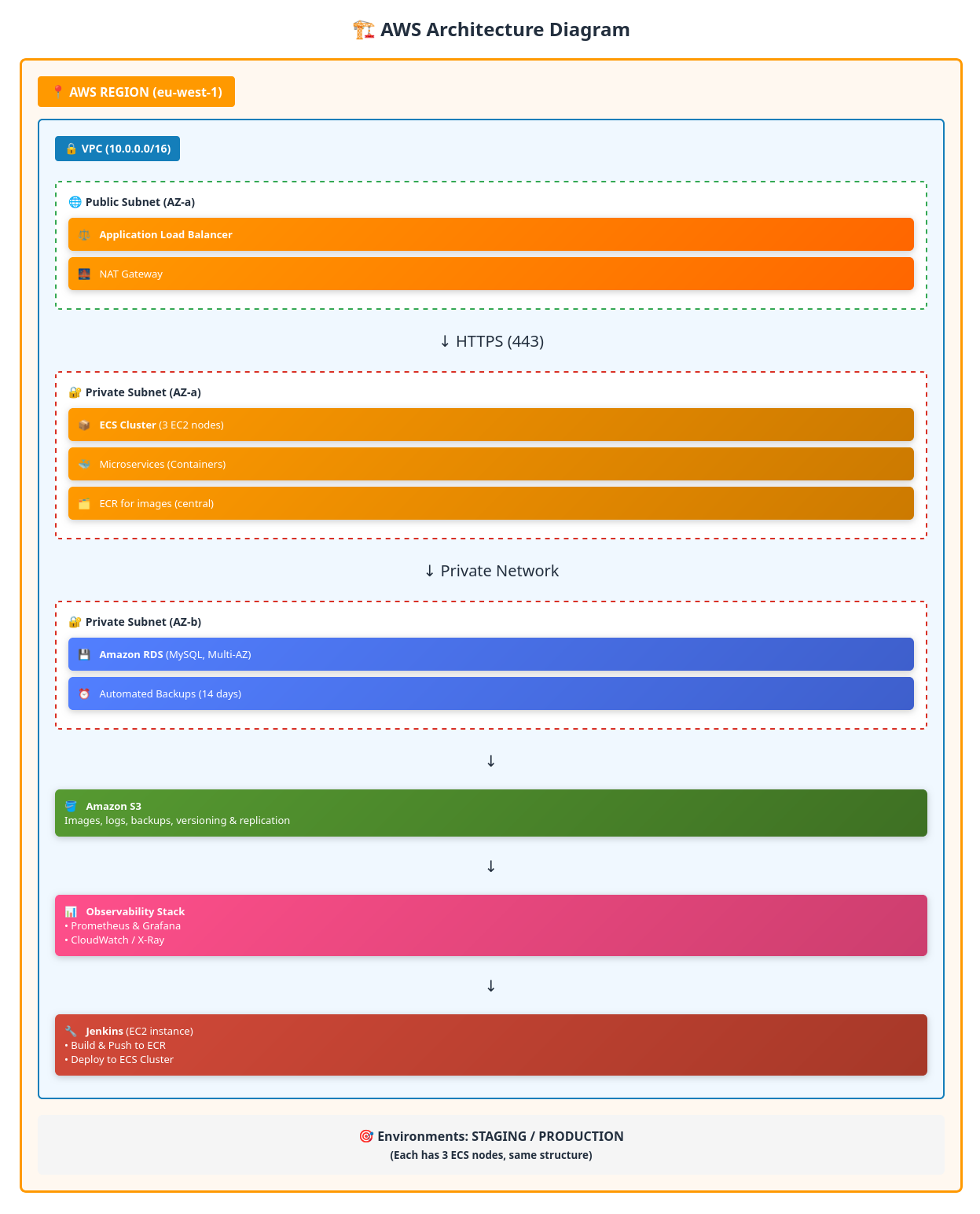
Solutions stack
| Layer | Technologies / Services |
|---|---|
| Application Layer | Spring Boot microservices |
| Runtime / Platform Layer | Docker, Amazon ECS, Amazon ECR |
| CI/CD Layer | Jenkins, Gitea |
| Infrastructure Layer | Terraform, Ansible, Amazon EC2, VPC, subnets, security groups |
| Database / Storage Layer | Amazon RDS (MySQL), Amazon S3, Amazon EBS |
| Observability Layer | Prometheus, Grafana, CloudWatch |
| Security Layer | AWS IAM, Security Groups, HTTPS via ALB, Secrets Manager |
| Continuity & Recovery Layer | RDS automated snapshots, S3 versioning/replication, multi-AZ RDS, Terraform for redeploy |
| Network & Delivery Layer | Application Load Balancer (ALB), Route 53, NAT Gateway, Internet Gateway |